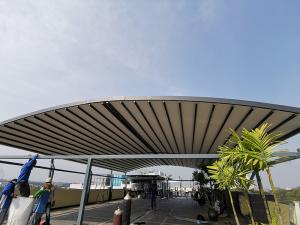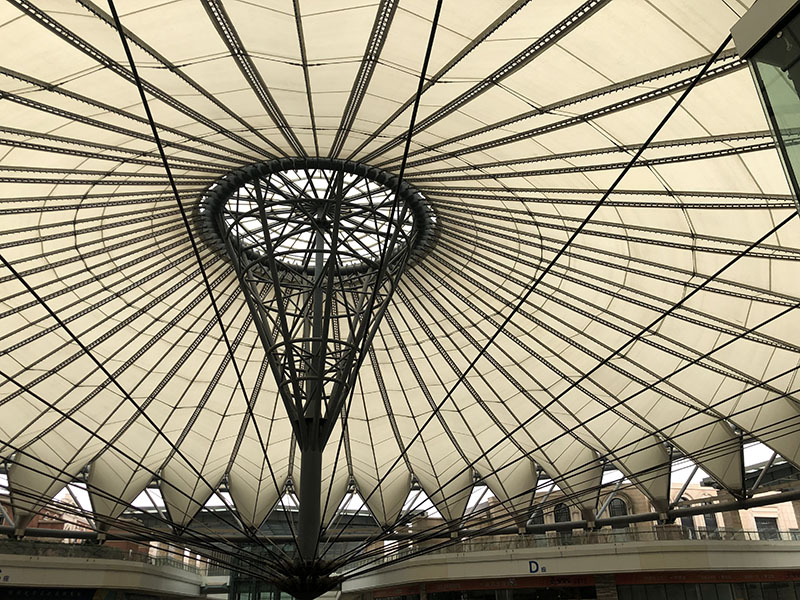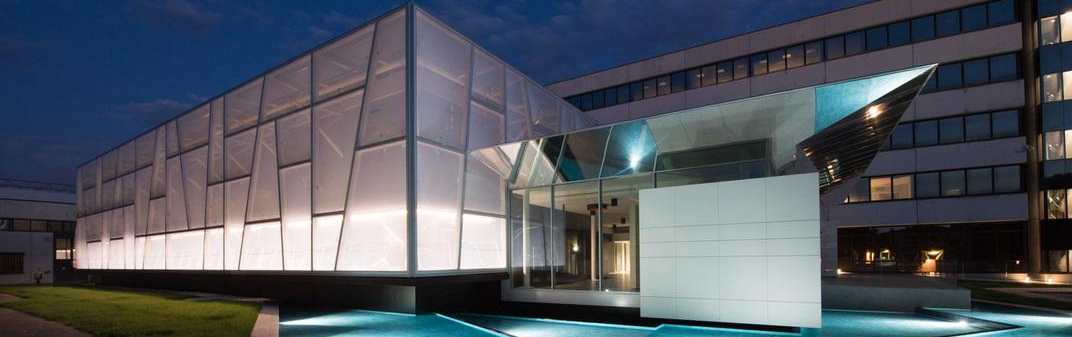
Tensile structures are becoming more popular because they fit several contemporary architectural priorities at once: long spans, lightweight construction, sustainability, speed, and iconic form.
1. Extreme structural efficiency
Membranes and cables work almost entirely in tension, which is the most efficient way to carry loads. Unlike beams or columns, tension elements do not buckle, so they can use material very efficiently. This allows very large column-free spans with relatively little steel or concrete.
2. Lightweight = lower cost and less material
Because the structure itself is light, foundations, supports, and substructure can be smaller. That reduces material use, embodied carbon, transport costs, and erection time. For covering large areas—stadiums, airports, plazas—this can be much cheaper than conventional roofs.
3. Fast prefabrication and installation
Membranes and cables are usually fabricated in a factory, then tensioned on site. This shortens construction time and improves quality control. It also makes tensile structures attractive for temporary events, exhibitions, and demountable buildings.
4. Design freedom and striking aesthetics
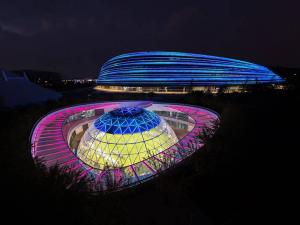
Tensile structures can form flowing, organic, double-curved surfaces that are hard to achieve with traditional rigid structures. Architects use them for landmark buildings, stadiums, pavilions, and transport hubs. Digital form-finding and parametric modeling have made these complex shapes much easier to design and engineer.
5. Material and technological advances
Modern materials such as PTFE-coated glass fiber, PVC-coated polyester, and ETFE foils are stronger, more durable, self-cleaning, fire-retardant, and translucent. High-strength cables and improved analysis software have also expanded what is possible.
6. Sustainability and daylighting
Tensile roofs can be translucent, reducing the need for artificial lighting. They can provide solar shading, encourage natural ventilation, and use far less material than conventional long-span roofs. Some systems can integrate photovoltaics or rainwater collection.
7. Functional flexibility
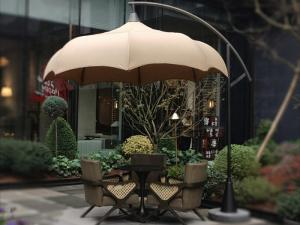
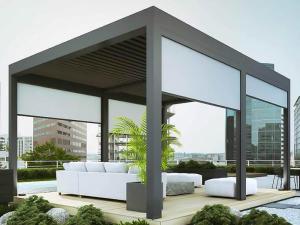
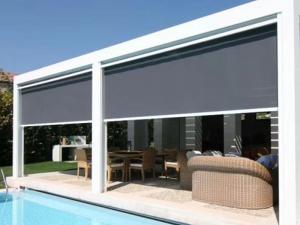
They are excellent for weather protection, UV control, and creating large sheltered public spaces. Retractable and convertible tensile roofs are popular in stadiums and arenas. They can also cover existing courtyards, streets, or archaeological sites without heavy intervention.
8. Good seismic and wind performance—when engineered well
Lightweight structures have less seismic mass, which can reduce earthquake forces. Their shape can also be tuned aerodynamically. However, wind is usually the governing load, so careful analysis is essential.
9. Urban branding and public space
Cities and institutions often want memorable, photogenic structures. Tensile architecture can create a strong identity and activate public space, which makes it attractive for regeneration projects and cultural buildings.
Caveats
Tensile structures are not always the best choice. They can be challenging for acoustics, thermal insulation, snow loading, rain ponding, and maintenance. They require double-curved surfaces, prestress, and precise engineering. They are also less suited to heavy loads or small, highly insulated buildings.
Overall, tensile structures are popular because they combine structural efficiency, material savings, fast construction, aesthetic freedom, and sustainability—exactly the qualities many contemporary architectural projects are looking for.


 un service en ligne
 +8613600065322
 canobbio@canobbio.com.cn
 +8613600065322